


As a business grows, managing customers, employees, sales, inventory, and daily operations can become more complicated than expected. Different departments may rely on separate applications, spreadsheets, or manual processes to complete their work. Although these methods may be sufficient initially, they can eventually make information harder to manage and business processes more difficult to coordinate. This is where customized software can provide a more organized approach.
For organizations searching for a Custom Software Development Company in Dehradun, the objective should be more than building another application. The right software should address genuine business challenges, simplify essential tasks, connect relevant systems, and support the organization’s long-term requirements.
Tejomaya Oneway Innovation LLP focuses on the value of customized digital solutions designed around business workflows, functional requirements, and evolving technology needs. With a clear development strategy, businesses can explore software that fits their operations instead of continually adjusting their processes to the limitations of standard applications.
What Does Custom Software Development Actually Mean?
Custom software development involves planning, designing, building, testing, and maintaining applications according to specific business requirements. Unlike ready-made software that offers a predefined set of features, customized software can be developed around an organization’s processes, users, and operational priorities.
For example, a company may require a centralized application to manage customer enquiries, while another business may need an inventory system connected to sales orders and reporting. An established organization might require several departments to access information through a shared platform with appropriate permissions.
Custom software development can include:
- Customer relationship management applications
- Enterprise resource planning systems
- Inventory and stock management software
- Employee and attendance management applications
- Sales and order processing systems
- Business process automation tools
- Customer portals and service applications
- Reporting dashboards and analytics
- API integrations and database management
- Industry-specific business applications
- Web-based business management platforms
- Customized mobile applications
The appropriate solution depends on the problems a business needs to solve. A well-planned application should prioritize useful functionality, straightforward navigation, reliability, and maintainability rather than unnecessary complexity.
Custom Software Development in Dehradun for Growing Businesses
Businesses in Dehradun operate across different sectors, including education, retail, hospitality, professional services, distribution, and emerging technology. Each sector has its own processes, customer expectations, and operational requirements.
Professional custom software development services in Dehradun can help businesses explore applications that align with these differences.
Centralized Business Information
When information is scattered across multiple files and applications, employees may spend additional time locating records or checking whether details are up to date. A customized system can organize relevant information in one environment, allowing authorized users to access the records they need.
Improved Workflow Management
Routine activities such as assigning tasks, processing requests, approving documents, and updating records can become difficult to coordinate as a team expands. Customized workflows can establish clearer steps and responsibilities.
Better Customer Management
Businesses can organize customer profiles, enquiries, communication records, service requests, and follow-up activities through suitable software modules. This can help teams maintain more consistent customer information.
More Useful Reporting
Management teams often need a clear view of sales, operational activities, pending work, or inventory. Customized dashboards can present relevant information in a format that supports informed business decisions.
Reduced Manual Work
Where appropriate, automation can help manage recurring tasks such as notifications, reminders, data transfers, and approval requests. This can reduce repetitive administrative effort while allowing employees to focus on work that requires their attention.
The value of customization comes from addressing specific operational difficulties, not simply from having more software features.
Understanding the Difference Between Custom and Ready-Made Software
Both custom and ready-made software can be useful, but they serve different requirements.
| Custom Software | Ready-Made Software |
| Developed around defined business requirements | Built for a broader group of users |
| Can support specialized workflows | Provides predefined workflows and features |
| May integrate with selected existing systems | Integration depends on available compatibility |
| Features can be planned around business priorities | Customization depends on the product’s capabilities |
| Development requires project planning and testing | May be quicker to implement for common needs |
| Maintenance depends on the chosen development and support arrangement | Updates and support depend on the software provider |
For businesses with standard requirements, ready-made software may be sufficient and cost-effective. However, organizations with specialized workflows, complex integrations, or unique reporting needs may find customized development more appropriate.
The important question is not which option is universally better, but which option offers the most practical fit for the business.
Why Businesses May Choose Customized Software Development
Every organization has its own operating procedures, approval systems, customer journey, and information requirements. Software that works well for one company may not suit another without adjustments.
A customized application can be planned around requirements such as:
- Business-specific dashboards and reports
- Customized forms and data fields
- Role-based access and user permissions
- Automated task assignments and approvals
- Integration with existing business applications
- Multi-user and multi-department access
- Customer communication functionality
- Mobile-friendly interfaces
- Inventory and order workflows
- Secure authentication and data handling
- Scalable application architecture
- Specialized industry-related functionality
Customization should always have a defined purpose. Before adding a feature, businesses should consider whether it solves a real problem, improves a workflow, or provides information that users genuinely need.
This approach helps maintain a manageable project scope and reduces the risk of developing an application that becomes unnecessarily difficult to use.
What Can Custom Business Software Include?
A business application can be developed around one operational function or several connected activities.
Customer and Lead Management
Businesses can organize enquiries, customer profiles, communication history, sales opportunities, and follow-up schedules. This is particularly useful when multiple employees manage customer relationships.
Inventory and Order Management
Depending on the business model, software can help track stock records, product movement, orders, purchasing activities, and related operational information.
Employee Management
Applications may include employee records, task assignments, leave requests, attendance-related workflows, and other administrative functions according to business requirements.
Finance and Operational Records
Relevant financial and administrative processes can be incorporated where appropriate. Accounting requirements, reporting standards, and integrations should be assessed before development begins.
Workflow Automation
Predefined rules can support activities such as sending notifications, assigning tasks, routing requests, and managing approval stages.
Reporting and Dashboards
Customized reports can present business information according to management priorities, helping users review selected performance indicators without relying entirely on manually prepared summaries.
Each module should be planned according to user needs, data requirements, and the wider software architecture.
Best Custom Software Development Company in Dehradun for Different Business Needs
Selecting the Best Custom Software Development Company in Dehradun involves understanding whether a development partner can translate business requirements into a reliable, usable application.
Different organizations may need different solutions.
Startups: Early-stage businesses may require a focused application for customer management, service delivery, task coordination, or internal administration. Starting with essential functionality can help keep the project manageable.
Retail Businesses: Retailers may explore software that connects product information, inventory, orders, customer records, and business reporting.
Educational Institutions: Educational organizations may require applications for enquiries, admissions, student records, schedules, and administrative coordination.
Service Providers: Service-based companies can consider appointment management, customer portals, employee assignments, service requests, and project tracking.
Distributors and Manufacturers: These organizations may require inventory tracking, purchasing workflows, order management, supplier information, and operational reports.
Growing Enterprises: Larger organizations may need multiple connected modules, different access permissions, integration with existing systems, and a development plan that accommodates future changes.
A suitable development partner should understand these differences and recommend an approach based on the organization’s actual needs rather than offering the same solution to every customer.
Important Software Features to Consider in 2026
Modern software planning should account for current operational needs while allowing room for future improvements.
Depending on the project, businesses may consider:
- Cloud-compatible architecture
- Responsive web interfaces
- Mobile accessibility
- Role-based access controls
- Secure authentication
- API integration
- Workflow automation
- Search and filtering functionality
- Customized reporting dashboards
- Data backup and recovery planning
- Performance monitoring
- Scalable databases and infrastructure
- AI-assisted functionality where genuinely useful
- Ongoing maintenance and security updates
Not every application requires all these features. The right selection depends on the software’s purpose, expected usage, security requirements, budget, and technical environment.
A practical system that performs its intended functions reliably is often more valuable than a complicated application filled with features that employees rarely use.
How to Choose a Custom Software Development Company in Dehradun
Selecting a development company is an important decision because software can influence daily operations long after its initial launch.
Before making a decision, businesses should evaluate several factors.
Understanding of requirements: The development team should understand the problem before recommending a technical solution.
Technical planning: The proposed architecture should reflect functionality, performance, security, and future maintenance needs.
User experience: Interfaces should make common tasks understandable and convenient for their intended users.
Integration capabilities: Existing applications, databases, and third-party tools should be evaluated for compatibility.
Testing and quality assurance: Important workflows, permissions, integrations, and performance should be tested before deployment.
Communication and transparency: Clear discussions about project scope, milestones, responsibilities, and changes can help manage expectations.
Post-launch support: Businesses should understand how maintenance, troubleshooting, updates, and future improvements will be handled.
When comparing development companies, prioritize relevant capabilities and a clear project approach instead of relying solely on promotional claims or initial quotations.
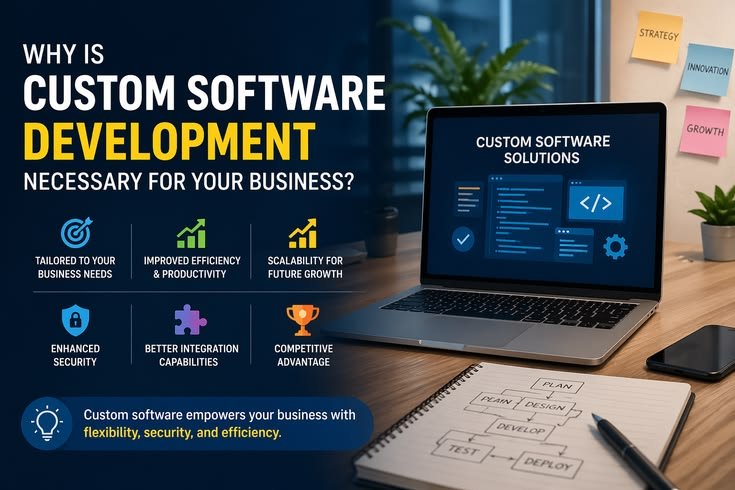
A Practical Custom Software Development Process
A structured development process helps translate a business idea into a usable digital solution.
1. Requirement Discovery
The development team identifies business objectives, user expectations, existing systems, operational difficulties, and essential features.
2. Workflow Planning
Current processes are reviewed to understand how information moves between employees, departments, and applications.
3. System Architecture and Design
The application structure, database requirements, user roles, integrations, and interface design are planned according to the agreed scope.
4. Software Development
Developers build the approved functionality and connect relevant components according to the project’s technical requirements.
5. Testing and Quality Assurance
The application is checked for functionality, usability, permissions, integration issues, and relevant security requirements.
6. Deployment and Training
After testing and approval, the application can be introduced into the intended business environment. User guidance may help employees adapt to the new system.
7. Maintenance and Improvement
After launch, updates, technical fixes, performance improvements, and additional features may be introduced as requirements evolve.
The overall timeline and cost depend on project complexity, functionality, integrations, and the agreed scope.
Common Mistakes to Avoid in Custom Software Development
Software projects can become difficult to manage when important decisions are delayed or requirements are unclear.
Common mistakes include:
- Starting development without defined objectives
- Adding features without assessing their value
- Ignoring the needs of actual users
- Overlooking integration requirements
- Treating security as an afterthought
- Skipping comprehensive testing
- Failing to plan data migration
- Underestimating training requirements
- Ignoring ongoing maintenance
- Choosing technology without considering long-term needs
Clear requirements, realistic planning, and regular communication can help businesses avoid unnecessary complications and keep the project focused on its intended purpose.
Why Tejomaya Oneway Innovation LLP?
Tejomaya Oneway Innovation LLP recognizes the importance of aligning digital solutions with practical business requirements. For organizations exploring customized software development, understanding operational needs is an essential starting point.
A business-focused approach considers the application’s purpose, intended users, required functionality, existing systems, and future development possibilities. These factors help establish a clearer direction before technical decisions are finalized.
For organizations searching for a Custom Software Development Company in Dehradun, the priority should be finding a development approach that addresses their actual challenges. From planning customized workflows to considering integrations, reporting, usability, and maintainability, every decision should contribute to the application’s intended business value.
The most useful software is not necessarily the one with the greatest number of features. It is the one that helps people complete important tasks, manage information appropriately, and work more effectively within their organization.
Building Better Business Processes Through Technology in 2026
As business requirements evolve, organizations need to review whether their existing systems continue to support their goals. Disconnected applications, repetitive tasks, and limited reporting can create opportunities to reconsider how technology is used.
Well-planned custom software development can help businesses establish more suitable workflows, connect relevant information, and build applications around their specific requirements.
For companies in Dehradun, the first step is to identify the operational challenge, evaluate available options, and define a realistic development scope. With careful planning and an appropriate technical approach, customized software can become a useful part of a business’s long-term digital strategy.
Frequently Asked Questions
What does a custom software development company in Dehradun do?
A custom software development company plans, builds, tests, and maintains applications designed around specific business requirements. Depending on the project, its work may include business analysis, interface design, integrations, automation, deployment, and ongoing technical support.
What is the difference between custom and ready-made software?
Custom software is developed around defined business requirements, while ready-made software provides predefined features for a wider audience. The appropriate choice depends on functionality, customization needs, budget, integration requirements, and long-term maintenance considerations.
Why choose the best custom software development company in Dehradun?
Businesses should evaluate technical capabilities, requirement analysis, communication, integration expertise, testing practices, security planning, and maintenance support. A suitable development partner should understand the business problem and recommend a practical solution.
Can custom software be developed for small businesses?
Yes. Small businesses can develop focused applications for customer management, inventory, scheduling, reporting, or internal workflows. The project should match current requirements and available resources, with future enhancements planned when necessary.
What affects custom software development costs?
Costs depend on application complexity, required features, interface design, integrations, infrastructure, security requirements, testing, and support arrangements. A clearly defined project scope helps establish a more relevant estimate.
Can custom software integrate with existing applications?
Yes, integration may be possible through APIs or other supported connection methods. Compatibility, data formats, security permissions, and technical limitations should be evaluated before implementation.
How long does custom software development take?
The timeline depends on the application’s scope, complexity, integrations, testing requirements, and project priorities. A requirements assessment and development plan can help establish realistic milestones.
How can Tejomaya Oneway Innovation LLP support software development needs?
Tejomaya Oneway Innovation LLP is the company featured for businesses exploring customized digital solutions. Project requirements, technical options, integrations, and ongoing support arrangements should be discussed and defined according to the specific business objectives.
Quick Information Link:- Best Software Company in Dehradun | How to Find the Right Software Partner
Website Design Company in Dehradun | How to Choose the Right Website Partner
