
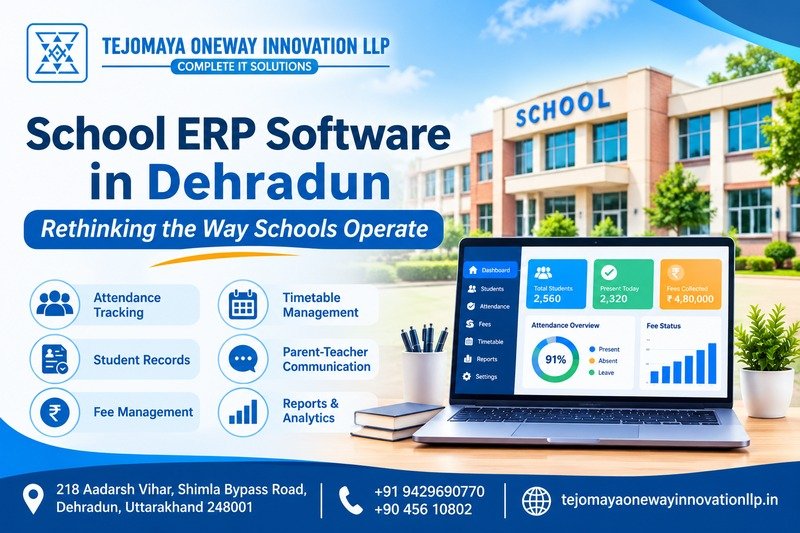
Managing an educational institution involves much more than conducting classes and completing academic schedules. Behind every well-organized school, there is a continuous process of handling student information, maintaining attendance, collecting fees, preparing examination records, coordinating teachers, and keeping parents informed. When these responsibilities are managed through separate registers or spreadsheets, even routine administrative activities can become difficult to coordinate.
This is where School ERP Software in Dehradun becomes a valuable consideration for educational institutions looking to improve their management processes. Instead of maintaining information across multiple disconnected systems, schools can use an integrated digital platform to organize important administrative and academic activities. The objective is not simply to replace paperwork but to create a more convenient way for school staff to access information, manage responsibilities, and maintain consistent communication.
For schools in Dehradun, adopting suitable school management technology can be a practical step towards building a more structured administrative environment while allowing educators to devote greater attention to students and academic development.
What Is School ERP Software and Why Does It Matter?
School ERP software is a digital management system designed to bring different school-related operations together. ERP stands for Enterprise Resource Planning, and in an educational setting, it helps organize information and processes connected with students, teachers, administration, fees, examinations, and communication.
Consider a school where the admission department maintains student details, the accounts team handles fee records, and teachers independently prepare attendance reports. If these activities operate separately, retrieving complete information may require additional coordination.
A school ERP system helps bring these functions into a connected environment. Depending on the selected software and available modules, authorized users can manage relevant information through a centralized platform.
For educational institutions, this approach can support better record organization, smoother coordination, and more consistent administrative practices.
Why Are Schools in Dehradun Considering Digital Management Systems?
Educational institutions regularly deal with information that needs to remain accurate, accessible, and properly maintained. As student numbers increase and administrative responsibilities expand, traditional recordkeeping methods may become harder to manage.
Here are some practical reasons schools consider digital management solutions:
- Organized student information: Maintain admission details, contact information, class records, and academic history systematically.
- Simplified attendance monitoring: Help teachers maintain attendance information without relying entirely on handwritten registers.
- Better fee administration: Keep track of fee structures, payment records, outstanding balances, and receipts.
- Academic coordination: Organize examination schedules, marks, results, and classroom timetables.
- Improved communication: Make it easier to share relevant information between school authorities, teachers, and parents.
- Convenient reporting: Access structured information when preparing administrative and academic reports.
A well-selected system can help reduce unnecessary administrative complications and make everyday school operations easier to coordinate.
Important Features of a Modern School ERP System
Not every educational institution has identical management requirements. However, certain modules are particularly useful when evaluating school management software.
1. Student Information Management
Student information is one of the most important parts of school administration. A digital student management module can maintain personal details, admission information, parent contacts, class allocation, and academic records.
Instead of searching through multiple files, authorized staff can access relevant student information from an organized system.
2. Attendance Management
Attendance tracking is a regular responsibility for teachers and administrative teams. A digital attendance module can help maintain daily attendance records, monitor student participation, and prepare attendance summaries.
It also makes it easier for school administrators to review attendance information when required.
3. Online Fee Management
Handling fee records requires accuracy and proper documentation. A fee management module can help organize payment details, fee categories, pending dues, receipts, and collection reports.
This can reduce confusion caused by scattered financial records and support more systematic accounting activities.
4. Examination and Result Management
Examinations involve several responsibilities, including scheduling, marks entry, result preparation, and academic reporting.
An examination management module can help organize these activities and maintain student performance records in a structured format.
5. Timetable and Class Management
Creating balanced timetables requires coordination between subjects, teachers, classrooms, and academic periods. Digital timetable management can help schools organize schedules and make necessary adjustments more conveniently.
6. Parent-Teacher Communication
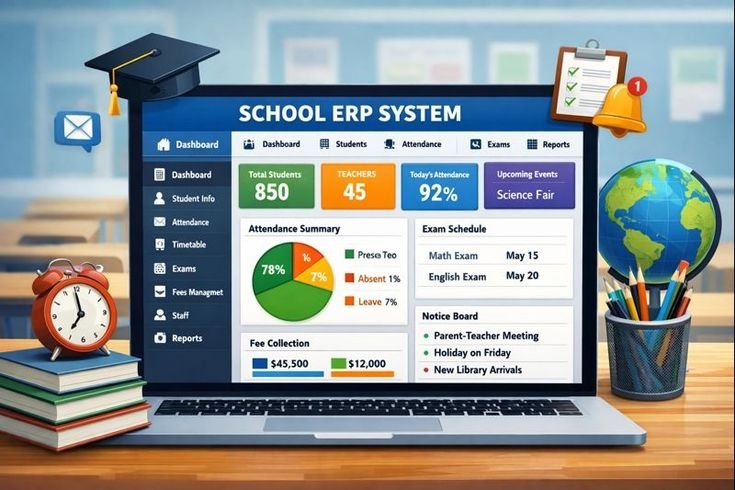
Parents appreciate receiving timely information about school activities and their children’s academic progress. Depending on the available communication features, an ERP platform can support announcements, attendance updates, examination information, and important notices.
How School ERP Software Can Improve Parent-School Coordination
A student’s educational journey involves continuous communication between teachers, parents, and school administrators. However, important information can sometimes get delayed when communication depends entirely on physical notices or individual phone calls.
School ERP Software in Dehradun can help educational institutions create a more organized communication process.
For example, a school may need to inform parents about an upcoming examination, a change in the academic schedule, a fee deadline, or a parent-teacher meeting. A suitable digital communication facility can help distribute such information through supported channels.
Consistent communication also gives parents better opportunities to stay informed about academic activities and important school announcements.
School ERP Software in Dehradun for Different Educational Institutions
Different schools have different operational priorities. A small institution may primarily need student records and attendance management, while a larger school may require multiple administrative modules.
Here are some examples:
- Private Schools: Manage student admissions, attendance, fee records, and academic information.
- CBSE Schools: Organize examination schedules, student performance records, and administrative activities.
- Growing Educational Institutions: Maintain structured information as student enrolments and staff responsibilities increase.
- Coaching Institutes: Coordinate student registrations, batch schedules, attendance, and fee information.
- Multi-Branch Schools: Explore centralized information management, depending on the software’s supported capabilities.
- Independent Academies: Organize student details, class schedules, and daily administrative responsibilities.
Selecting software according to actual institutional requirements is more useful than choosing a system simply because it offers numerous features.
How to Select the Right School ERP Software
Choosing an ERP solution requires careful evaluation because the system may become an important part of everyday school operations.
Before making a decision, educational administrators should consider the following points:
- Understand existing challenges: Identify which administrative activities require better organization.
- Evaluate essential modules: Check whether student management, attendance, fees, and examination functions meet institutional requirements.
- Check ease of use: Teachers and administrative staff should be able to understand the system without unnecessary complexity.
- Review data security: Understand user permissions, information protection, and available backup arrangements.
- Consider customization: Evaluate whether the platform can accommodate the school’s specific management procedures.
- Understand technical support: Check what assistance is available during implementation and regular usage.
- Review overall suitability: Compare the software’s capabilities with the institution’s operational needs and budget.
A thoughtful selection process can help schools avoid paying for unnecessary functions while ensuring that important requirements are covered.
Traditional School Administration vs Digital ERP Management
The difference between manual administration and an integrated digital system becomes clearer when everyday activities are compared.
| Management Area | Traditional Approach | Digital ERP Approach |
| Student Records | Paper files and registers | Organized digital profiles |
| Attendance | Manual attendance registers | Digital attendance records |
| Fee Records | Separate payment registers | Structured fee information |
| Examinations | Manual result preparation | Digital marks and result management |
| Timetables | Printed schedules | Digitally managed schedules |
| Communication | Notices and individual calls | Supported digital communication |
| Reporting | Manual record compilation | Organized reports and summaries |
Digital management does not eliminate the need for administrative supervision. Instead, it provides tools that can make information handling more organized and accessible.
Common School Management Challenges an ERP System Can Address
Many administrative difficulties arise not because schools lack dedicated staff but because information is spread across different records and processes.
For instance, preparing a student’s complete academic history may require checking several registers. Similarly, reviewing outstanding fees or compiling attendance information can consume additional staff time when records are maintained separately.
A suitable ERP system can help address these situations by organizing student information, maintaining structured records, simplifying routine reporting, and supporting communication.
The effectiveness of the system depends on proper implementation, accurate data entry, staff training, and regular usage.
How Tejomaya Oneway Innovation LLP Connects Technology with Education Management
Choosing digital software for an educational institution requires an understanding of both technology and everyday administrative requirements. A solution should support the school’s actual working processes rather than introduce unnecessary complexity.
Tejomaya Oneway Innovation LLP recognizes the importance of practical digital solutions for organizations seeking more structured ways to manage their operations.
For institutions exploring School ERP Software in Dehradun, the focus should be on identifying suitable management requirements, understanding essential software functions, and selecting an approach that supports administrative and academic coordination.
Whether a school wants to improve student record management, organize fee information, monitor attendance, or streamline examination-related activities, selecting an appropriate digital management solution is an important part of its technology planning.
Practical Ways Schools Can Use ERP Software
The usefulness of school ERP software becomes easier to understand through everyday situations.
- During Admissions: Administrative teams can maintain student registration details and admission information systematically.
- During Morning Attendance: Teachers can record attendance and help maintain updated classroom information.
- During Fee Collection: Accounts departments can organize payment entries and review pending dues.
- Before Examinations: Administrators can coordinate examination schedules and related academic information.
- After Result Preparation: Schools can maintain marks and performance records for future reference.
- During Parent Meetings: Relevant student information can help teachers prepare for more productive discussions.
These examples demonstrate how connected information management can support routine school activities.
Key Factors to Evaluate Before Implementing School ERP Software
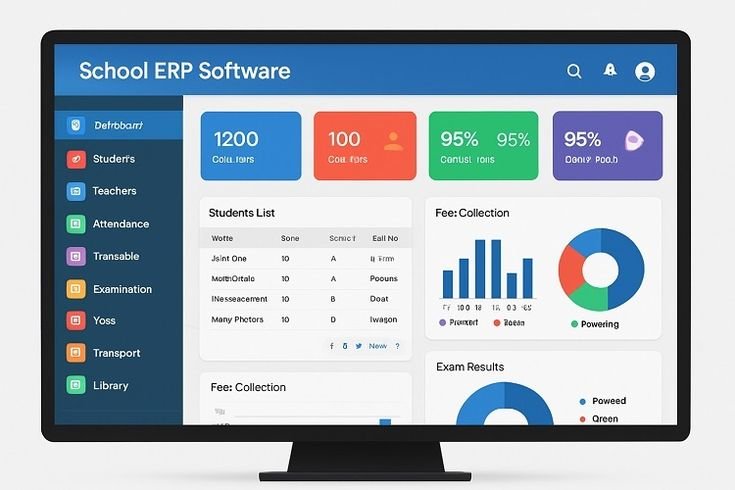
| Important Factor | Why Schools Should Consider It |
| User-Friendly Interface | Makes daily software usage easier |
| Student Management | Helps maintain organized student records |
| Attendance Tracking | Supports regular attendance monitoring |
| Fee Administration | Organizes payment information |
| Examination Module | Helps manage academic records |
| Communication Tools | Supports parent-school coordination |
| Data Protection | Encourages responsible information management |
| Technical Assistance | Helps address operational difficulties |
Frequently Asked Questions
1. What is School ERP Software in Dehradun?
School ERP Software in Dehradun refers to digital management solutions that help educational institutions organize student records, attendance, fee information, examinations, staff details, and administrative activities.
2. How does school ERP software help administrators?
It can bring different administrative functions into an organized system, making it easier to maintain records, access information, coordinate responsibilities, and prepare reports.
3. Can school ERP software manage student attendance?
Yes. Attendance management is a common ERP module that allows teachers and authorized administrators to maintain and review student attendance records digitally.
4. Is school ERP software useful for small schools?
Yes. Small educational institutions can also benefit from digital recordkeeping, fee management, attendance tracking, and organized student information, depending on their requirements.
5. Can ERP software simplify school fee management?
A fee management module can help maintain fee structures, payment entries, pending dues, receipts, and collection reports in an organized manner.
6. How does school ERP software support parents?
Depending on the available features, parents may receive important announcements, attendance information, examination updates, and other school-related communication.
7. What should schools check before choosing an ERP solution?
Schools should evaluate essential modules, ease of use, customization, data protection, reporting facilities, implementation requirements, technical assistance, and overall suitability.
8. Why should educational institutions consider digital school management?
Digital management can help schools reduce scattered paperwork, organize information, improve administrative coordination, and maintain more consistent records.
Final Thoughts
A well-managed school depends on the coordination of many responsibilities, from classroom activities and student records to financial administration and parent communication. When these processes are organized effectively, teachers and administrators can spend less time dealing with scattered information and more time focusing on educational priorities.
School ERP Software in Dehradun offers educational institutions an opportunity to approach these responsibilities through a more connected and structured management system. The right solution should match the school’s size, working methods, and long-term requirements.
With Tejomaya Oneway Innovation LLP, educational institutions can explore the importance of suitable digital management solutions and take a thoughtful approach towards improving their administrative processes. Ultimately, successful school management is not about adopting technology for its own sake; it is about using the right tools to make everyday educational operations more organized, accessible, and manageable.
