
Managing a pathology laboratory involves much more than conducting medical tests and preparing diagnostic reports. Every day, laboratories handle patient registrations, sample details, test requests, billing information, report preparation, and administrative responsibilities. When these activities depend heavily on paperwork or disconnected systems, keeping everything organized can become difficult.
This is where Pathology Management Software in Dehradun can make a meaningful difference. Digital laboratory solutions help diagnostic centres organize their daily processes, maintain patient information, and manage important administrative activities through a more structured system.
For pathology laboratories, diagnostic centres, and healthcare service providers, adopting suitable software is not simply about moving records from paper to a computer. It is about creating a smoother working environment where information can be managed more conveniently and routine responsibilities become easier to coordinate.
What Is Pathology Management Software and Why Does It Matter?
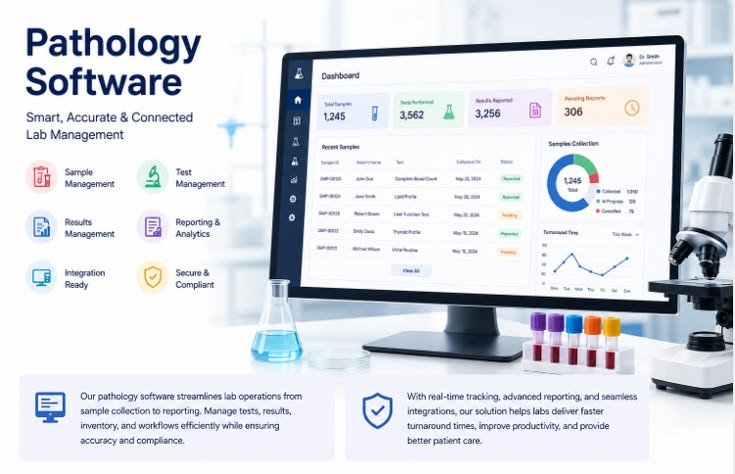
Pathology management software is a digital solution designed to help laboratories handle different administrative and operational activities from a centralized platform.
Instead of maintaining separate records for every task, laboratories can use an organized system to manage patient details, test information, billing records, and diagnostic reports.
A properly planned Pathology Management Software in Dehradun can support activities such as:
- Patient registration and information management
- Test booking and service records
- Sample identification and tracking
- Laboratory report preparation
- Billing and payment documentation
- Test information organization
- Administrative record management
- Access to stored laboratory information
The exact functionality depends on the software’s design and the requirements of the laboratory. The main objective is to make everyday management more organized and less dependent on scattered records.
Why Are Pathology Laboratories Adopting Digital Management Systems?
A laboratory deals with multiple activities that need to remain properly coordinated. Even a small diagnostic centre may receive several test requests, manage different patient records, and prepare reports throughout the day.
Handling these responsibilities manually can increase administrative pressure, particularly when information needs to be located or updated quickly.
This is one reason why Laboratory Management Software in Dehradun is becoming a relevant consideration for diagnostic businesses looking to improve their internal processes.
Digital management can help laboratories:
- Maintain patient information in an organized format.
- Reduce dependence on repetitive paperwork.
- Manage test-related information more conveniently.
- Keep billing and administrative records structured.
- Improve coordination between different activities.
- Make stored information easier to retrieve.
- Establish a more consistent approach to daily operations.
Technology does not replace professional medical judgment. Instead, it supports the administrative side of laboratory operations so that staff can manage routine responsibilities more systematically.
Essential Features to Consider in Pathology Lab Software
Choosing software without understanding its actual capabilities can create difficulties later. Before selecting a system, laboratory owners should consider which functions are important for their working environment.
Here are some useful features to evaluate.
1. Patient Registration and Record Management
Patient information is an important part of laboratory administration. A digital registration system can help organize names, contact information, registration details, and related records in a structured manner.
2. Test Booking and Sample Management
Laboratories handle different types of diagnostic requests. Software with suitable test-booking and sample-management functions can help staff organize requests and maintain relevant sample information.
3. Laboratory Report Generation
Preparing and maintaining reports is a significant part of laboratory operations. A report-management feature can help organize test results, report formats, and associated patient information.
4. Billing and Payment Management
Financial documentation should remain properly organized. Billing functionality can help laboratories maintain service charges, payment entries, and transaction-related records.
5. Test Profile Management
Different laboratories provide different diagnostic services. A suitable system should allow relevant test information and service details to be organized according to operational requirements.
6. Data Security and Access Management
Laboratories manage confidential patient information. Appropriate access controls, secure data handling, backup arrangements, and privacy-conscious system design should be considered during software selection.
7. Administrative Management
A centralized system can help organize everyday administrative responsibilities and make it easier for authorized staff to access the information required for their work.
How Can Pathology Management Software Improve Daily Laboratory Operations?
The usefulness of digital software becomes clearer when we look at everyday laboratory activities.
Consider a diagnostic centre that receives multiple patient registrations, handles different test requests, and prepares reports throughout the day. When information is stored across different registers and spreadsheets, employees may need additional time to locate and update records.
With suitable Diagnostic Centre Software in Dehradun, these activities can be brought into a more structured digital workflow.
Some practical improvements include:
- Better information organization: Patient and test-related details can be maintained systematically.
- Simplified administration: Routine record management becomes easier to coordinate.
- Convenient report handling: Laboratory reports can be organized through digital records.
- Structured billing: Payment and service information can be maintained in one system.
- Improved workflow visibility: Staff can manage different operational activities with greater clarity.
- Easier record retrieval: Authorized users can locate stored information without depending entirely on physical files.
The overall benefit depends on how well the software matches the laboratory’s actual requirements and how effectively employees use it.
Benefits of Choosing Pathology Management Software in Dehradun
For local diagnostic centres and pathology businesses, selecting suitable digital software can support long-term operational improvements.
Some important benefits include:
Organized Laboratory Administration
Managing different laboratory activities through a planned digital system can make everyday administrative work more systematic.
Reduced Paperwork
Digital recordkeeping can reduce the need for maintaining multiple physical registers for routine administrative information.
Convenient Information Access
Authorized employees can access relevant stored records according to their assigned permissions.
Improved Record Consistency
Using structured data-entry processes can help laboratories maintain more consistent patient, test, and billing information.
Support for Business Expansion
As a diagnostic centre grows, the volume of records and administrative activities may also increase. Scalable software can help accommodate changing operational requirements.
Better Staff Coordination
When relevant information is organized in a shared system, employees can coordinate different responsibilities more conveniently.
How to Select the Right Laboratory Management Software?
Not every laboratory operates in the same way. A small pathology centre may have different requirements from a large diagnostic facility offering multiple testing services.
Therefore, choosing the right Laboratory Management Software in Dehradun requires careful consideration.
Before making a decision, evaluate the following factors:
| Selection Factor | What to Consider |
| Ease of Use | Whether staff can understand and operate the system comfortably |
| Customization | Whether the software can accommodate laboratory-specific requirements |
| Reporting | Whether report formats meet operational needs |
| Data Security | Whether suitable privacy and access controls are available |
| Scalability | Whether the system can support future business requirements |
| Technical Support | Whether assistance is available when required |
| Data Backup | Whether appropriate backup and recovery arrangements are provided |
| Integration | Whether the software can work with relevant existing systems |
A thoughtful selection process can help laboratories avoid unnecessary complications and choose software that supports their actual workflow.
Common Problems Pathology Laboratories May Face Without Digital Software
Manual administration is not necessarily unsuitable for every small laboratory, but it can become challenging as operational activities increase.
Some common difficulties include:
Managing Multiple Patient Records
Searching through physical registers can take additional time, particularly when laboratories handle a growing number of records.
Maintaining Test Information
When test details are stored separately, keeping information updated and organized may become difficult.
Handling Reports
Preparing, arranging, and retrieving reports through manual processes can increase administrative workload.
Organizing Billing Records
Separate payment registers and billing documents may create additional work when information needs to be reviewed.
Maintaining Consistent Information
Repeated manual entries can create the possibility of incomplete or inconsistent records.
Digital management can help address these administrative challenges through structured information handling and suitable workflow planning.
How Tejomaya Oneway Innovation LLP Connects Businesses With Digital Software Solutions
Technology is most useful when it addresses a genuine business requirement rather than adding unnecessary complexity.
Tejomaya Oneway Innovation LLP focuses on digital technology and software development solutions that help businesses explore more organized ways of managing their operations.
For diagnostic centres and laboratory businesses researching Pathology Management Software in Dehradun, selecting a suitable digital solution begins with understanding their operational requirements.
Important considerations include patient record organization, report management, administrative processes, billing requirements, data handling, and future scalability.
Businesses exploring customized software development can evaluate solutions according to their specific workflows instead of relying on a one-size-fits-all approach.
Through its digital solutions expertise, Tejomaya Oneway Innovation LLP aims to help businesses understand how appropriate technology can contribute to more structured and efficient operations.
Which Types of Healthcare Businesses Can Benefit From Pathology Software?
Different healthcare organizations may have different reasons for considering laboratory management solutions.
Independent Pathology Laboratories
Independent laboratories can explore digital systems for organizing patient information, test requests, reports, and billing activities.
Diagnostic Centres
Diagnostic centres handling multiple services may benefit from structured record management and coordinated administrative workflows.
Multi-Location Laboratories
Businesses operating across different locations may consider software that supports centralized information management, subject to their technical and operational requirements.
Medical Testing Facilities
Testing facilities can evaluate digital tools for maintaining test-related information and organizing routine administrative activities.
Growing Healthcare Businesses
Healthcare businesses planning to expand their operations can consider scalable software that accommodates changing management requirements.
Pathology Software vs Traditional Laboratory Recordkeeping
Both manual and digital approaches have their own operational considerations. Understanding the differences can help laboratory owners make an informed decision.
| Management Area | Traditional Recordkeeping | Digital Software |
| Patient Information | Paper registers and files | Structured digital records |
| Test Management | Manual entries | Organized digital information |
| Report Handling | Physical documentation | Digital report management |
| Billing | Separate registers | Software-based billing records |
| Information Retrieval | Manual searching | Searchable stored information |
| Data Management | Paper-based organization | Centralized digital handling |
The most suitable approach depends on laboratory size, workflow complexity, available resources, and technology requirements.
Frequently Asked Questions
What is Pathology Management Software in Dehradun?
Pathology Management Software in Dehradun refers to digital software solutions that help pathology laboratories and diagnostic centres manage patient records, test information, reports, billing, and other administrative activities.
How does pathology software help diagnostic centres?
Pathology software can help diagnostic centres organize patient information, manage test-related records, maintain billing details, and handle laboratory reports through a more structured digital system.
Which features should pathology lab software include?
Useful features to evaluate include patient registration, sample management, test booking, report generation, billing, administrative controls, data security, and backup arrangements.
Is laboratory management software useful for small pathology labs?
Yes. Small laboratories can also consider digital management software when they want to organize records, simplify administrative activities, and prepare for future operational requirements.
Can pathology software manage patient reports?
Depending on its functionality, pathology software can support digital report preparation, organization, storage, and retrieval of laboratory-related information.
What is the difference between pathology software and diagnostic centre software?
Pathology software generally focuses on laboratory-related activities, while diagnostic centre software may cover a wider range of administrative and service-management requirements depending on its design.
Why is data security important in laboratory management software?
Laboratory systems may contain confidential patient and diagnostic information. Appropriate access permissions, secure data handling, backup processes, and privacy safeguards are important for protecting these records.
How can businesses choose customized pathology management software?
Businesses should first identify their daily workflow, required features, reporting needs, user roles, security expectations, and future expansion plans before evaluating customized software solutions.
Looking Ahead: Making Laboratory Management More Organized
The future of laboratory administration is closely connected with the ability to manage information accurately, maintain organized records, and coordinate everyday activities efficiently.
For pathology laboratories and diagnostic centres, moving towards digital management can be a practical step when existing administrative processes become difficult to maintain.
Choosing the right Pathology Management Software in Dehradun requires more than comparing features. It involves understanding the laboratory’s working style, identifying operational challenges, and selecting technology that supports its actual requirements.
With a thoughtful approach to software development and digital transformation, Tejomaya Oneway Innovation LLP can be explored by businesses looking to understand suitable digital solutions for their operational needs.
The real value of technology lies in making everyday work more manageable, keeping important information organized, and creating a stronger foundation for future growth.
