
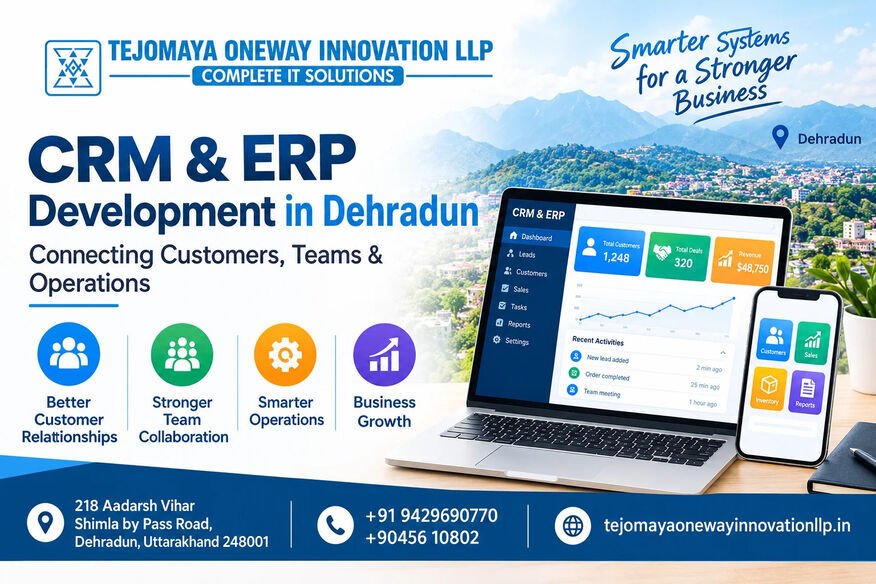
As a business grows, managing customers, sales, employees, inventory, accounts, and daily operations through separate tools can become increasingly difficult. Information may be available, but finding the right information at the right time can still take unnecessary effort. This is where connected business software can make everyday operations more organized.
For organizations looking for CRM and ERP development companies in Dehradun, the objective should be more than getting a new software system. A useful solution should understand how the business operates, simplify repetitive processes, connect relevant departments, and give teams better access to the information they need.
Tejomaya Oneway Innovation LLP helps businesses explore customized CRM and ERP development approaches designed around practical workflows, user requirements, business processes, and long-term digital goals.
What Do CRM and ERP Development Solutions Actually Do?
CRM and ERP are two different categories of business software, although they can work together as part of a connected digital environment.
A CRM system primarily helps businesses manage relationships with prospects and customers. It can organize leads, sales activities, follow-ups, customer conversations, support requests, and other customer-related information.
An ERP system focuses more on internal operations. Depending on the organization’s requirements, it may bring areas such as finance, inventory, purchasing, HR, sales, orders, and reporting into a centralized environment.
The development process involves planning, designing, customizing, integrating, testing, deploying, and maintaining these systems according to the specific requirements of a business.
Businesses may consider CRM and ERP development for:
- Customer and lead management
- Sales pipeline management
- Inventory control
- Order processing
- Employee management
- Accounting and financial workflows
- Procurement management
- Customer support
- Business reporting
- Workflow automation
- Department-level coordination
- Centralized business information
The right solution depends on what the organization needs to improve rather than simply how many features the software contains.
CRM and ERP Development in Dehradun for Growing Organizations
Businesses across Dehradun are becoming increasingly dependent on digital systems to manage customer interactions and internal operations. From startups and service providers to retailers, distributors, educational organizations, and established enterprises, different businesses have different technology requirements.
Professional CRM and ERP development services in Dehradun can help organizations create systems that are aligned with their actual workflows.
Centralized Business Information
Instead of maintaining important information across multiple disconnected files and applications, a centralized system can provide authorized users with easier access to relevant business data.
Organized Customer Management
CRM functionality can help sales and support teams maintain customer records, monitor interactions, schedule follow-ups, and understand the status of leads and opportunities.
Connected Internal Operations
ERP functionality can bring important operational activities together, helping departments work with more consistent information.
Improved Process Visibility
Dashboards and reports can help management understand what is happening across sales, operations, inventory, or other relevant areas without depending entirely on manually prepared updates.
Reduced Repetitive Work
Automation can support recurring tasks such as notifications, approvals, assignments, reminders, and data movement between connected processes.
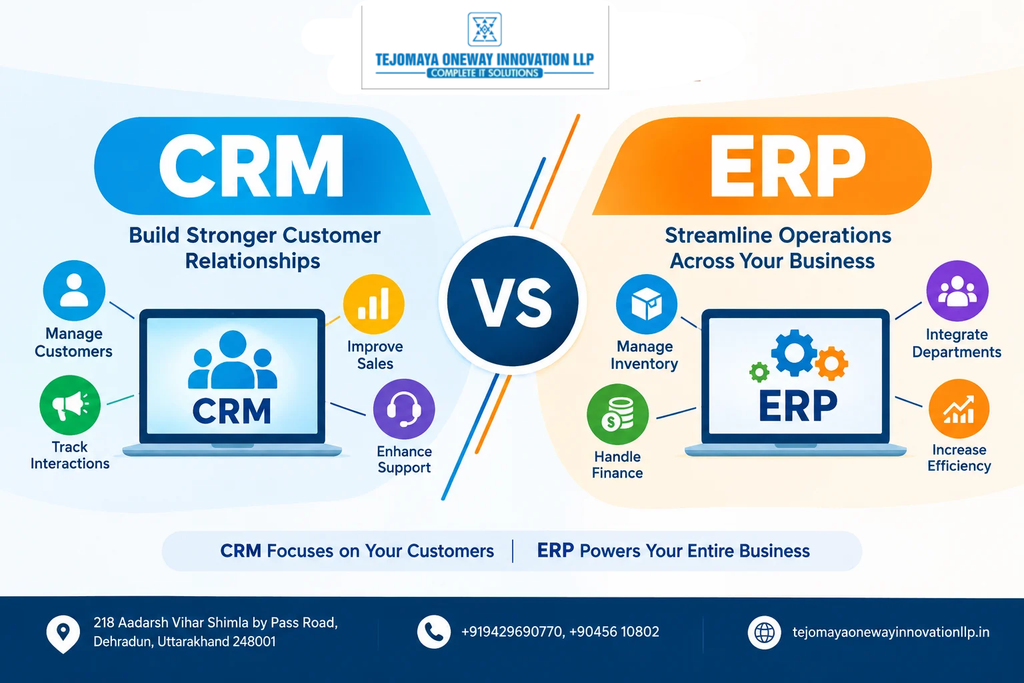
Understanding the Difference Between CRM and ERP
CRM and ERP are sometimes treated as if they are interchangeable, but they solve different problems.
| CRM | ERP |
| Primarily focuses on customers | Primarily focuses on business operations |
| Manages leads and opportunities | Manages resources and workflows |
| Supports sales and marketing | Supports finance, inventory, HR and operations |
| Tracks customer interactions | Tracks internal processes |
| Helps improve customer relationships | Helps improve operational coordination |
| Provides sales-related insights | Provides broader business visibility |
For some businesses, CRM may be the immediate priority. Others may require ERP capabilities first. Larger or rapidly growing organizations may benefit from connecting both.
The important question is not “CRM or ERP?” but rather “Which business processes need better visibility, coordination, or automation?”
Why Businesses May Choose Customized CRM and ERP Development
Off-the-shelf software can be useful for many organizations, but every business does not operate in exactly the same way.
A company may have a specific approval process, unusual reporting requirements, specialized customer journey, multiple branches, unique inventory workflow, or third-party systems that need to communicate with the new platform.
Custom development can provide greater flexibility around these requirements.
A tailored CRM or ERP solution may include:
- Customized dashboards
- Business-specific workflows
- User-based permissions
- Automated approvals
- Custom reports
- API integrations
- Multi-user access
- Mobile-friendly interfaces
- Notification systems
- Customer communication tools
- Inventory workflows
- Sales automation
- Scalable architecture
Customization should have a clear purpose. The goal is to make the software more useful for the organization, not simply to add more features.
What Can CRM Development Include?
A CRM platform can be designed around the complete customer journey.
Lead Management
Capture and organize enquiries from different sources while helping sales teams understand which leads require attention.
Sales Pipeline
Create a structured view of opportunities so teams can monitor progress from initial enquiry through conversion.
Customer Profiles
Maintain relevant customer information, communication history, preferences, transactions, and other useful records in one place.
Follow-Up Management
Automated reminders and task assignments can help reduce the chances of important follow-ups being missed.
Customer Support
Businesses can organize support requests, service activities, communication records, and customer issues through a centralized system.
Reports and Dashboards
Management can use customized reports to understand sales activity, lead sources, customer trends, and team performance.
What Can ERP Development Include?
ERP development can focus on the internal side of business management.
Inventory Management
Track stock levels, product movement, availability, and related inventory activities according to business requirements.
Finance and Accounts
Relevant financial workflows can be organized within a centralized business system where appropriate.
Procurement
Purchase requests, vendor information, approvals, and purchasing workflows can be structured for better coordination.
Human Resource Management
Employee information, attendance-related processes, leave workflows, and other HR requirements can be incorporated where needed.
Order Management
Businesses can manage order-related information and connect it with relevant operational processes.
Business Reporting
ERP dashboards can provide management with a broader view of operational performance and business activity.
Best CRM & ERP Development Services in Dehradun for Different Requirements
The needs of a startup may be very different from those of an established organization. A professional development approach should therefore be adaptable.
Startups:
A growing startup may require a simple CRM for managing leads, customers, tasks, and sales activities while keeping the system ready for future expansion.
Retail Businesses:
Retail organizations may benefit from connected customer, sales, inventory, billing, and reporting workflows.
Service Companies:
Service-based businesses can use CRM functionality for enquiries, customer records, appointments, follow-ups, and support management.
Distributors:
Distribution businesses may require inventory, purchasing, sales orders, customer management, and operational reporting.
Growing Enterprises:
Larger businesses may need integrated CRM and ERP environments that connect multiple departments, users, locations, and business processes.
This is why Best CRM & ERP Development Services in Dehradun should be approached as a business-specific requirement rather than a one-size-fits-all package.
Important Features to Consider in 2026
Modern business software should be designed with both current requirements and future possibilities in mind.
Depending on the project, businesses may consider:
- Cloud-ready architecture
- Responsive interfaces
- Advanced dashboards
- Workflow automation
- API integration
- Role-based access
- Real-time information
- Search and filtering
- Automated notifications
- Data backup strategies
- Scalable infrastructure
- Analytics and reporting
- Mobile accessibility
- AI-assisted business insights where genuinely useful
Not every business needs every feature. A practical system is usually more valuable than an unnecessarily complicated one.
CRM and ERP Integration Can Connect the Business Journey
One of the biggest advantages of integrating CRM and ERP is the ability to connect customer-facing activity with internal operations.
For example:
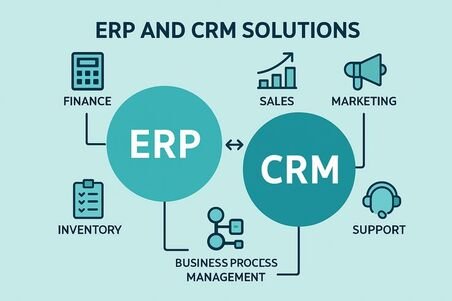
Lead → Sales Opportunity → Customer → Order → Inventory → Billing → Delivery → Support
A CRM can manage the early customer journey, while ERP can support the operational stages that follow.
When these systems communicate effectively, teams may spend less time transferring information manually between departments. Sales teams can have greater visibility into relevant operational information, while internal teams can receive information needed to fulfil customer requirements.
The exact integration depends on the business model, software architecture, APIs, security requirements, and data structure.
How to Select CRM and ERP Development Companies in Dehradun
Choosing a development company should involve more than comparing prices or looking at screenshots of previous websites.
Businesses should consider:
- Understanding of business workflows
- CRM and ERP development experience
- Customization capability
- Integration expertise
- User experience
- Data security approach
- Scalability
- Testing process
- Technical communication
- Post-launch support
- Maintenance capability
A development partner should first understand what the business is trying to solve and then recommend an appropriate technology approach.
Related Blogs:- Bulk WhatsApp Messages in Dehradun | How It Works, Benefits & Business Uses
Social Media Marketing in Dehradun | How It Works, Benefits, Strategies & Cost
Best IT Company in Dehradun | Services, Solutions, Benefits & Pricing
A Practical CRM and ERP Development Process
A structured development process can help reduce unnecessary complications.
1. Requirement Discovery
The team studies the business, users, departments, existing tools, challenges, and objectives.
2. Workflow Planning
Current processes are mapped to identify where information moves, where delays occur, and which tasks may benefit from automation.
3. System Architecture
The required modules, integrations, user roles, database structure, and technical framework are planned.
4. UI and UX Design
Interfaces are designed to make important information and actions easy for employees to understand and use.
5. Development and Integration
The required CRM, ERP, custom modules, APIs, and integrations are developed according to the approved requirements.
6. Testing
Core workflows, permissions, forms, reports, integrations, responsiveness, and security-related functionality are tested before deployment.
7. Deployment
After final checks and approval, the system can be introduced into the business environment.
8. Training and Support
Users may require guidance to understand the new system and adapt their daily workflows.
9. Continuous Improvement
As the business changes, additional modules, integrations, automation, reports, or improvements may be introduced.
Common CRM and ERP Development Mistakes
Businesses can face problems when software is developed without sufficient planning.
Common issues include:
- Building unnecessary features
- Ignoring employee usability
- Poor integration planning
- Complicated navigation
- Weak access controls
- Inadequate testing
- Ignoring scalability
- Poor data migration planning
- Lack of user training
- Neglecting post-launch maintenance
A successful project should focus on solving real business problems rather than creating software simply because the technology is available.
Why Tejomaya Oneway Innovation LLP?
Tejomaya Oneway Innovation LLP approaches CRM and ERP development with an emphasis on practical business requirements, usability, functionality, and long-term flexibility.
For organizations exploring CRM and ERP development companies in Dehradun, the company can support businesses in understanding their requirements and developing digital solutions around relevant workflows.
From customer management and sales processes to operational systems, integrations, dashboards, and customized functionality, the objective is to create technology that can work naturally within the organization.
Businesses searching for Best CRM & ERP Development Services in Dehradun should ultimately look for a partner that understands both technology and business processes. A good solution should not simply look modern; it should make everyday work more organized and useful.
Building a More Connected Business in 2026
The real value of CRM and ERP development is not the software itself. It is what the software enables people to do with better information.
When customer records, sales activities, internal operations, inventory, reporting, and other important processes are properly connected, businesses can reduce information gaps and create a more organized working environment.
For organizations planning their digital strategy in 2026, CRM and ERP development can provide a foundation for better coordination, automation, customer management, and informed decision-making.
With the right planning, technology, and development partner, a business can build a digital system that evolves alongside its changing requirements rather than becoming another disconnected tool.
Frequently Asked Questions
What is CRM and ERP development?
CRM and ERP development involves creating, customizing, integrating, and maintaining business software. CRM generally focuses on customers and sales, while ERP supports broader internal operations such as inventory, finance, HR, procurement, and reporting.
What is the difference between CRM and ERP?
CRM is primarily designed to manage customer relationships, leads, sales activities, and communication. ERP is designed to coordinate internal business operations and resources. Both can be integrated when a business needs connected customer and operational workflows.
Why choose CRM and ERP development companies in Dehradun?
A local development partner can provide an accessible business relationship while understanding the requirements of organizations operating in and around Dehradun. However, businesses should primarily evaluate technical expertise, customization, communication, scalability, security, and support.
Can CRM and ERP be customized for a specific business?
Yes. CRM and ERP platforms can be customized according to workflows, user roles, reporting needs, integrations, industry requirements, and business processes. The level of customization depends on the project’s objectives and technical requirements.
Can CRM and ERP systems work together?
Yes. CRM and ERP systems can be integrated so relevant customer, sales, order, inventory, billing, and operational information can move between connected workflows.
What should businesses consider before developing CRM or ERP software?
Businesses should first identify their current problems, workflows, users, data requirements, integrations, security expectations, reporting needs, and future growth plans. This helps prevent unnecessary features and creates a more focused development strategy.
Are CRM and ERP solutions useful for small businesses?
They can be, provided the solution is appropriately scaled. A small business does not necessarily need a large enterprise platform. A focused CRM, ERP module, or integrated system can be developed around its actual requirements and future plans.
How can Tejomaya Oneway Innovation LLP help?
Tejomaya Oneway Innovation LLP can help businesses plan and develop customized digital solutions around customer management, business operations, automation, integrations, reporting, and other relevant CRM or ERP requirements.
