
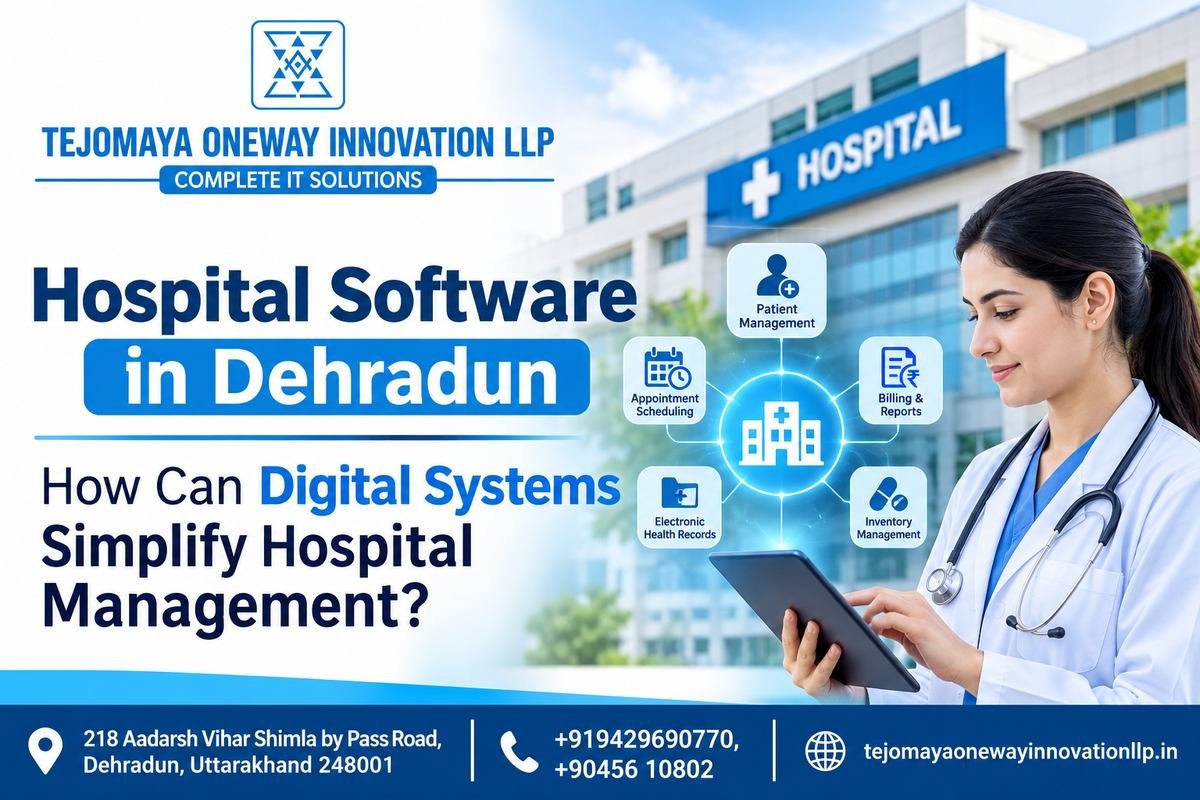
Running a hospital involves much more than treating patients. Behind every consultation, medical examination, and treatment plan, several activities must work together smoothly. Patient registration, appointment scheduling, medical documentation, billing, pharmacy coordination, and staff management all require proper attention. When these responsibilities depend heavily on paperwork or disconnected systems, even routine hospital activities can become difficult to manage.
This is where Hospital Software in Dehradun becomes an important consideration for modern healthcare organizations. Digital hospital management solutions can help bring essential administrative and operational activities into a more organized environment. Instead of maintaining separate records for different departments, hospitals can explore centralized systems that make information management and daily coordination more convenient.
For hospitals, clinics, nursing homes, and healthcare providers in Dehradun, adopting suitable technology is not simply about replacing traditional paperwork. It is about creating a more connected working environment where administrative teams can manage responsibilities efficiently while medical professionals focus on patient care.
Why Is Digital Management Becoming Essential for Modern Hospitals?
Healthcare organizations handle sensitive information and time-dependent activities throughout the day. A small administrative delay can affect appointment schedules, billing procedures, or communication between departments.
Traditional recordkeeping may work for smaller operations initially, but managing increasing patient information through multiple registers and spreadsheets can become challenging.
A digital hospital management system can help healthcare facilities organize several activities, including:
- Patient registration and information management
- Doctor appointment scheduling
- Medical history documentation
- OPD and IPD administration
- Billing and payment records
- Pharmacy and medicine inventory
- Laboratory coordination
- Staff and departmental information
- Administrative reporting
The main advantage is having a structured approach to everyday hospital responsibilities. When information is organized properly, authorized staff can spend less time searching through records and more time handling their assigned work.
What Makes Hospital Management Software Useful for Healthcare Facilities?
Hospital Management Software in Dehradun is designed to support the administrative and operational requirements of healthcare organizations. It brings different hospital activities into a digital environment, depending on the features included in the selected solution.
For example, when a patient visits a hospital, the reception team may need to register personal details, arrange a consultation, and coordinate billing. The medical team may require access to relevant patient information, while the administration department needs organized operational records.
A suitable software system can connect these activities through a structured workflow.
Rather than treating every department as a separate operation, hospitals can use technology to improve coordination and maintain more consistent information across their internal processes.
Essential Features Every Hospital Should Consider
Choosing hospital software requires understanding which functions are genuinely useful for a healthcare facility. Not every hospital has identical requirements, so the right combination of features depends on its size, departments, and working procedures.
1. Patient Registration and Record Management
Patient information is an essential part of hospital operations. Digital registration can help maintain organized patient profiles, contact information, visit history, and relevant medical documentation.
2. Appointment and Doctor Scheduling
Managing consultation schedules manually can create confusion, particularly when multiple doctors and departments operate simultaneously. Appointment management features can help organize consultation timings and reduce scheduling conflicts.
3. OPD and IPD Management
Outpatient and inpatient departments have different administrative requirements. Software with OPD and IPD management capabilities can help organize patient visits, admission details, treatment-related records, and discharge documentation.
4. Hospital Billing and Invoice Management
Billing involves several details, including consultation charges, diagnostic services, treatment expenses, and other applicable costs. Hospital billing software can help organize these entries and generate structured invoices.
5. Pharmacy and Inventory Management
Hospitals need to monitor medicines, medical supplies, and available stock. Pharmacy management features can support inventory records, stock updates, and medicine-related documentation.
6. Laboratory Management
Diagnostic departments handle test requests, patient details, and laboratory reports. Integrated laboratory management features can help organize these activities and improve coordination with other hospital departments.
7. Reports and Administrative Insights
Organized reports can help hospital administrators review operational information, understand departmental activities, and make informed management decisions.
How Can Hospital Software Improve Patient Management?
A patient’s experience begins before meeting the doctor. Registration, waiting time, appointment coordination, billing, and access to relevant information all contribute to the overall hospital experience.
A well-planned Patient Management Software solution can help organize these interactions.
Consider a patient visiting a multi-speciality hospital for a consultation. The reception team needs to record the visit, arrange the appointment, and direct the patient to the appropriate department. After consultation, additional diagnostic or billing activities may follow.
When these steps are managed through disconnected processes, unnecessary delays and repeated information entry may occur.
A centralized digital workflow can help make these activities more coordinated. However, the actual improvement depends on the software configuration, staff training, and the hospital’s implementation process.
Which Healthcare Facilities Can Benefit From Hospital Software?
Different healthcare organizations have different operational priorities. A solution that works for a large hospital may not be necessary for a small clinic.
Multi-Speciality Hospitals: Can explore integrated systems for managing multiple departments, doctors, appointments, billing, and patient information.
Private Hospitals and Nursing Homes: Can use digital management solutions to organize admissions, consultations, medical records, and administrative responsibilities.
Small Clinics: May benefit from simpler clinic management software focused on patient registration, appointments, consultation records, and billing.
Diagnostic Centres: Can consider software that supports test registration, laboratory workflows, report management, and billing.
Specialty Healthcare Centres: Can evaluate customized workflows according to their specific treatment services and administrative requirements.
The important consideration is selecting software that matches actual working needs instead of investing in unnecessary features.
Cloud-Based vs. Traditional Hospital Software: What Should You Know?
One important decision when choosing Healthcare Management Software is understanding the difference between cloud-based and on-premise solutions.
| Comparison Factor | Cloud-Based Software | On-Premise Software |
| Accessibility | Available through supported internet-connected devices | Generally accessed through the hospital’s local infrastructure |
| Infrastructure | Hosted on cloud infrastructure | Installed on local servers or systems |
| Maintenance | Depends on the service provider and agreement | Requires internal or contracted maintenance |
| Data Management | Depends on hosting and backup arrangements | Managed through the hospital’s infrastructure |
| Customization | Depends on the platform | Depends on the software architecture |
| Cost Structure | May involve recurring subscription charges | May involve installation and infrastructure expenses |
Neither approach is automatically suitable for every healthcare organization. Hospitals should evaluate their technical resources, data protection requirements, accessibility needs, maintenance arrangements, and long-term operating costs before deciding.
How Does Automation Help Hospitals Manage Daily Responsibilities?
Hospital administration involves several repetitive activities that require accuracy and consistency. Appointment entries, billing records, stock updates, and routine documentation can consume considerable staff time.
Automation features, where available, can simplify selected tasks and reduce repetitive manual work.
Some practical applications include:
- Generating structured patient registration records.
- Organizing appointment schedules.
- Preparing invoices from recorded service details.
- Maintaining medicine inventory information.
- Managing routine administrative reports.
- Organizing admission and discharge documentation.
- Tracking selected departmental activities.
Automation should support healthcare professionals rather than replace their judgment. Medical decisions, clinical assessments, and sensitive patient-related actions must remain under appropriate professional supervision.
Common Hospital Management Problems That Digital Software Can Address
Hospitals may encounter operational difficulties when their information and administrative processes are not properly coordinated.
Disorganized Patient Information
Maintaining records across different registers can make information retrieval difficult. Digital records can provide a more structured way to organize patient information.
Appointment Scheduling Conflicts
Manual scheduling may lead to overlapping appointments or communication gaps. Digital scheduling tools can help maintain clearer consultation calendars.
Complicated Billing Procedures
Multiple service entries can make billing management difficult. A structured billing system can help organize charges and transaction records.
Difficulty Monitoring Inventory
Without updated stock information, tracking medicines and medical supplies can become challenging. Inventory management features can support more organized monitoring.
Limited Administrative Visibility
When departments maintain separate reports, administrators may find it difficult to review overall operational activities. Centralized reporting can make relevant information easier to access.

What Should Hospitals Check Before Choosing Software in Dehradun?
Finding the right Hospital Software in Dehradun requires more than comparing prices or counting available features. Healthcare organizations should examine how a system will fit into their everyday working environment.
Important factors include:
| Selection Factor | What Hospitals Should Evaluate |
| Ease of Use | Can staff operate the system comfortably? |
| Customization | Can workflows match hospital requirements? |
| Data Security | Are appropriate access controls and protection measures available? |
| Scalability | Can the system accommodate future operational growth? |
| Integration | Can relevant departments and systems work together? |
| Technical Support | Is assistance available when technical issues arise? |
| Reporting | Does the software provide useful administrative reports? |
| Implementation | Are installation, migration, and training requirements clearly explained? |
Hospitals should also review data backup arrangements, access permissions, privacy practices, and applicable healthcare data protection requirements before selecting a solution.
Why Consider Tejomaya Oneway Innovation LLP for Healthcare Software Solutions?
Technology becomes valuable when it addresses real operational requirements. For healthcare organizations, selecting software should begin with understanding how their departments work, what information they manage, and where their existing processes need improvement.
Tejomaya Oneway Innovation LLP is an IT solutions company that can be considered by organizations exploring digital software requirements in Dehradun.
For businesses researching Hospital Software in Dehradun, it is important to evaluate solutions according to patient management, administrative workflows, billing requirements, departmental coordination, and future technology needs.
A thoughtful software development approach should consider:
- Understanding the hospital’s operational requirements.
- Identifying important administrative workflows.
- Evaluating suitable software functionality.
- Considering customization requirements.
- Prioritizing data security and controlled access.
- Planning for maintenance and future improvements.
Rather than choosing technology simply because it offers numerous features, healthcare organizations should focus on whether the proposed solution addresses their actual working challenges.
Tejomaya Oneway Innovation LLP can be approached to discuss software-related requirements and explore suitable digital solutions for healthcare operations.
How Different Hospital Departments Can Use Digital Management Systems
The usefulness of hospital software becomes clearer when its role is considered across individual departments.
Reception Department: Can organize patient registration, appointment information, and visitor records.
Doctors and Medical Professionals: Can access relevant patient information through authorized digital record systems, depending on the software’s capabilities.
Nursing Department: Can use suitable systems to organize assigned patient-related documentation and departmental information.
Pharmacy Department: Can maintain medicine records, stock information, and dispensing-related entries.
Laboratory Department: Can organize diagnostic requests, test details, and report-related information.
Accounts Department: Can manage billing entries, invoices, payment records, and financial documentation.
Hospital Administration: Can review operational reports and coordinate different administrative activities.
When these departments follow connected processes, hospitals can work towards a more organized management environment.
What Is the Future of Hospital Management Technology?
Healthcare technology continues to develop as hospitals explore digital records, cloud infrastructure, workflow automation, and integrated management platforms.
Future hospital management systems may increasingly focus on interoperability, intelligent reporting, improved patient information management, and more flexible software architecture.
However, technology adoption should remain practical. Hospitals need solutions that are reliable, secure, understandable for staff, and appropriate for their available infrastructure.
For healthcare organizations in Dehradun, the opportunity lies in choosing technology that supports present requirements while allowing room for future development.
Frequently Asked Questions
1. What is Hospital Software in Dehradun?
Hospital Software in Dehradun refers to digital management solutions that help hospitals organize activities such as patient registration, appointments, billing, medical records, pharmacy operations, and administrative reporting.
2. Which features should hospital management software include?
Important features may include patient registration, appointment scheduling, OPD and IPD management, electronic medical records, billing, pharmacy management, laboratory coordination, and reporting.
3. Can small hospitals and clinics use hospital management software?
Yes. Small hospitals and clinics can consider solutions designed around their operational requirements. They may begin with essential functions such as patient records, appointments, and billing.
4. How does hospital software help manage patient records?
It can provide a structured digital environment for maintaining patient profiles, visit history, medical documentation, and other relevant information, subject to authorized access.
5. Is cloud-based hospital management software a good option?
Cloud-based software can offer accessibility through supported internet-connected devices. However, hospitals should evaluate hosting arrangements, privacy controls, backup policies, security, and service reliability.
6. What affects the cost of hospital software?
Pricing may depend on the number of users, software modules, customization, hosting infrastructure, implementation, data migration, training, and ongoing maintenance.
7. Can hospital software manage appointments and billing together?
Depending on its functionality, hospital management software can combine appointment scheduling and billing within a connected administrative system.
8. How should hospitals select a software development company in Dehradun?
Hospitals should examine technical expertise, requirement analysis, customization capabilities, security practices, implementation planning, support arrangements, and the suitability of the proposed solution.
9. Is customized hospital software better than ready-made software?
It depends on the hospital’s requirements. Ready-made software may suit organizations with standard workflows, while customized solutions may be worth considering when specific operational requirements cannot be addressed through existing platforms.
Final Thoughts
Managing a healthcare organization requires coordination, accurate information, and consistent administrative processes. As patient requirements and hospital operations become more complex, depending entirely on manual documentation can create unnecessary management challenges.
Choosing the right Hospital Software in Dehradun can help healthcare facilities move towards more organized patient records, structured appointments, coordinated billing, and improved administrative visibility.
The best solution is not necessarily the one with the largest number of features. It is the one that fits the hospital’s actual requirements, supports its employees, and provides a dependable foundation for future development.
For hospitals, clinics, and healthcare organizations exploring digital transformation, Tejomaya Oneway Innovation LLP can be a point of contact for discussing software requirements and potential technology solutions.
A better-managed hospital begins with better-organized processes, and the right technology can play an important role in making that possible.
